


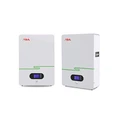
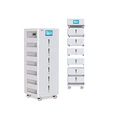
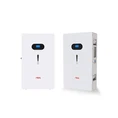
What is a low temperature lithium battery?
Low temperature lithium batteries are energy storage and power supply devices specially developed for cold environments below the freezing point and made with special battery materials and processes. Its discharge capacity and working performance are generally required to work normally in an environment of -40℃ , with the discharge capacity remaining above 80% and the minimum working temperature reaching -50℃ .
Low-temperature lithium batteries use VGCF and surface area of (2000±500)㎡/g of activated carbon as additives and their matching positive and negative electrode materials, injected with electrolyte containing special additives to ensure the low-temperature discharge function of lithium batteries, while high temperature 70 ℃ shelved for 24h volume change rate ≦ 0.5%, with the safety and storage function of conventional lithium batteries.
What are the types of low-temperature lithium batteries?
Low-temperature lithium batteries are divided into three series according to their use environment: civilian low-temperature batteries, special low-temperature batteries, extreme environment ultra-low temperature batteries.
1, Civilian low-temperature lithium battery: -20 ℃ battery @0.2C discharge accounted for more than 90% of the rated capacity; -30 ℃ battery 0.2C discharge accounted for more than 85% of the rated capacity;
2, Special low temperature lithium battery: -40 ℃ battery @0.2C discharge accounted for more than 80% of the rated capacity;
3, Extreme environment ultra-low temperature lithium battery: -50 ℃ battery @0.2C discharge accounted for more than 60% of the rated capacity;