


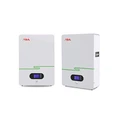
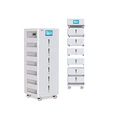

A discharge/charge cycle is commonly understood as the full discharge of a charged battery with subsequent recharge, but this is not always the case. Batteries are seldom fully discharged, and manufacturers often use the 80 percent depth-of-discharge (DoD) formula to rate a battery. This means that only 80 percent of the available energy is delivered and 20 percent remains in reserve. Cycling a battery at less than full discharge increases service life, and manufacturers argue that this is closer to a field representation than a full cycle because batteries are commonly recharged with some spare capacity left.
There is no standard definition as to what constitutes a discharge cycle. Some cycle counters add a full count when a battery is charged. A smart battery may require a 15 percent discharge after charge to qualify for a discharge cycle; anything less is not counted as a cycle. A battery in a satellite has a typical DoD of 30–40 percent before the batteries are recharged during the satellite day. A new EV battery may only charge to 80 percent and discharge to 30 percent. This bandwidth gradually widens as the battery fades to provide identical driving distances. Avoiding full charges and discharges reduces battery stress.
A hybrid car only uses a fraction of the capacity during acceleration before the battery is recharged. Cranking the motor of a vehicle draws less than 5 percent energy from the starter battery, and this is also called a cycle in the automotive industry. Reference to cycle count must be done in context with the respective duty.
Reference to discharge cycle or cycle count does not relate equally well to all battery applications. One example where counting discharge cycles does not reflect state-of-life accurately is in a storage device (ESS). These batteries supplement renewable energies from wind power and photovoltaic by delivering short-term energy when needed and storing if in excess. The time duration between charge and discharged can be in milliseconds; a typical battery state-of-charge is 40–60%. Rather than cycle count, coulomb counting may be used as a means of measuring wear and tear.