



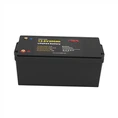
Hey there! As a supplier of Brick Batteries, I often get asked about how the State of Charge (SOC) estimation works for these powerhouses. So, I thought I'd break it down for you in this blog post.
Let's start with the basics. The State of Charge (SOC) is like the fuel gauge of your Brick Battery. It tells you how much energy is left in the battery at any given time. Knowing the SOC is crucial, whether you're using our Brick 20KWh Battery For Home ESS to power your home during a blackout or our Solar Home 15KWh Brick 51.2v 300ah Lifepo4 ESS for your solar energy storage needs.
The Importance of SOC Estimation
Why is SOC estimation so important? Well, imagine you're relying on your Brick Battery to keep your lights on, your fridge running, and your devices charged. You need to know how much energy you have left so you can plan your usage accordingly. If you don't have an accurate SOC estimate, you might end up running out of power when you need it most.
On the other hand, if you overestimate the SOC, you might not charge your battery when you should, which can lead to premature battery degradation. So, getting an accurate SOC estimate is essential for both the performance and longevity of your Brick Battery.
Methods of SOC Estimation
There are several methods used to estimate the SOC of a battery, and each has its own pros and cons. Let's take a look at some of the most common ones.
1. Open Circuit Voltage (OCV) Method
The OCV method is one of the simplest ways to estimate the SOC of a battery. It's based on the fact that the voltage of a battery is related to its SOC. When a battery is fully charged, its voltage is at its highest, and as it discharges, the voltage decreases.


To use the OCV method, you first need to measure the open circuit voltage of the battery, which is the voltage when the battery is not connected to any load. Then, you can use a lookup table or a mathematical model to convert the voltage to an SOC value.
The OCV method is relatively easy to implement and doesn't require any complex calculations. However, it has some limitations. For example, the relationship between voltage and SOC can be affected by factors such as temperature, battery age, and the rate of charge or discharge. So, the OCV method might not be very accurate in real-world applications.
2. Coulomb Counting Method
The Coulomb counting method, also known as the ampere-hour counting method, is another popular way to estimate the SOC of a battery. It works by measuring the amount of charge that enters or leaves the battery over time.
To use the Coulomb counting method, you need to measure the current flowing in and out of the battery and integrate it over time. The difference between the initial charge and the cumulative charge gives you an estimate of the SOC.
The Coulomb counting method is more accurate than the OCV method, especially when the battery is being charged or discharged at a constant rate. However, it also has some drawbacks. For example, it requires accurate current measurement, and any errors in the current measurement can accumulate over time, leading to inaccurate SOC estimates.
3. Kalman Filtering Method
The Kalman filtering method is a more advanced technique for SOC estimation. It combines the OCV method and the Coulomb counting method to get a more accurate estimate of the SOC.
The Kalman filter is a mathematical algorithm that uses a series of measurements over time to estimate the state of a system. In the case of battery SOC estimation, the Kalman filter takes into account the voltage, current, and temperature measurements to estimate the SOC.
The Kalman filtering method is more accurate than the OCV and Coulomb counting methods, especially in dynamic operating conditions. However, it requires more complex calculations and a good understanding of the battery model.
How We Estimate the SOC of Our Brick Batteries
At our company, we use a combination of the Coulomb counting method and the Kalman filtering method to estimate the SOC of our Brick Batteries. This approach allows us to take advantage of the strengths of both methods and minimize their limitations.
We start by using the Coulomb counting method to keep track of the charge that enters and leaves the battery. Then, we use the Kalman filtering method to correct any errors in the Coulomb counting and to account for factors such as temperature and battery aging.
Our advanced battery management system (BMS) continuously monitors the voltage, current, and temperature of the battery and uses these measurements to update the SOC estimate in real-time. This ensures that you always have an accurate and up-to-date SOC reading for your Brick Battery.
Benefits of Our SOC Estimation Technology
By using our advanced SOC estimation technology, you can enjoy several benefits.
1. Accurate SOC Estimates
Our combination of the Coulomb counting and Kalman filtering methods provides highly accurate SOC estimates, even in dynamic operating conditions. This means you can trust the SOC reading on your battery and plan your energy usage accordingly.
2. Extended Battery Life
Accurate SOC estimation helps to prevent overcharging and over-discharging, which can significantly extend the life of your battery. By using our Brick Batteries with our advanced SOC estimation technology, you can get more years of reliable service from your battery.
3. Improved Safety
Knowing the SOC of your battery is also important for safety reasons. Overcharging or over-discharging a battery can lead to thermal runaway, which can cause the battery to catch fire or explode. Our accurate SOC estimation technology helps to prevent these dangerous situations by ensuring that the battery is always operated within its safe limits.
Conclusion
In conclusion, SOC estimation is a crucial aspect of battery management, and getting an accurate estimate is essential for the performance, longevity, and safety of your Brick Battery. At our company, we use a combination of the Coulomb counting and Kalman filtering methods to provide highly accurate SOC estimates for our LiFePO4 51.2V 200Ah 10Kwh Brick Battery and other products.
If you're interested in learning more about our Brick Batteries or have any questions about SOC estimation, don't hesitate to reach out. We'd be happy to discuss your energy storage needs and help you find the right solution for your home or business. Whether you're looking for a reliable backup power source or a way to store your solar energy, our Brick Batteries are a great choice. Contact us today to start the conversation and explore the possibilities!
References
- Xia, K., & Peng, H. (2007). A comparative study of equivalent - circuit models for Li - ion batteries. Journal of Power Sources, 164(2), 805 - 811.
- Plett, G. L. (2004). Extended Kalman filtering for battery management systems of LiPB - based HEV battery packs: Part 1. Background. Journal of Power Sources, 134(2), 252 - 261.
- Tremblay, O., & Dessaint, L. A. (2009). Experimental validation of a battery dynamic model for EV applications. IEEE Transactions on Vehicular Technology, 58(2), 919 - 928.